The Laugh Track Has Left The Room
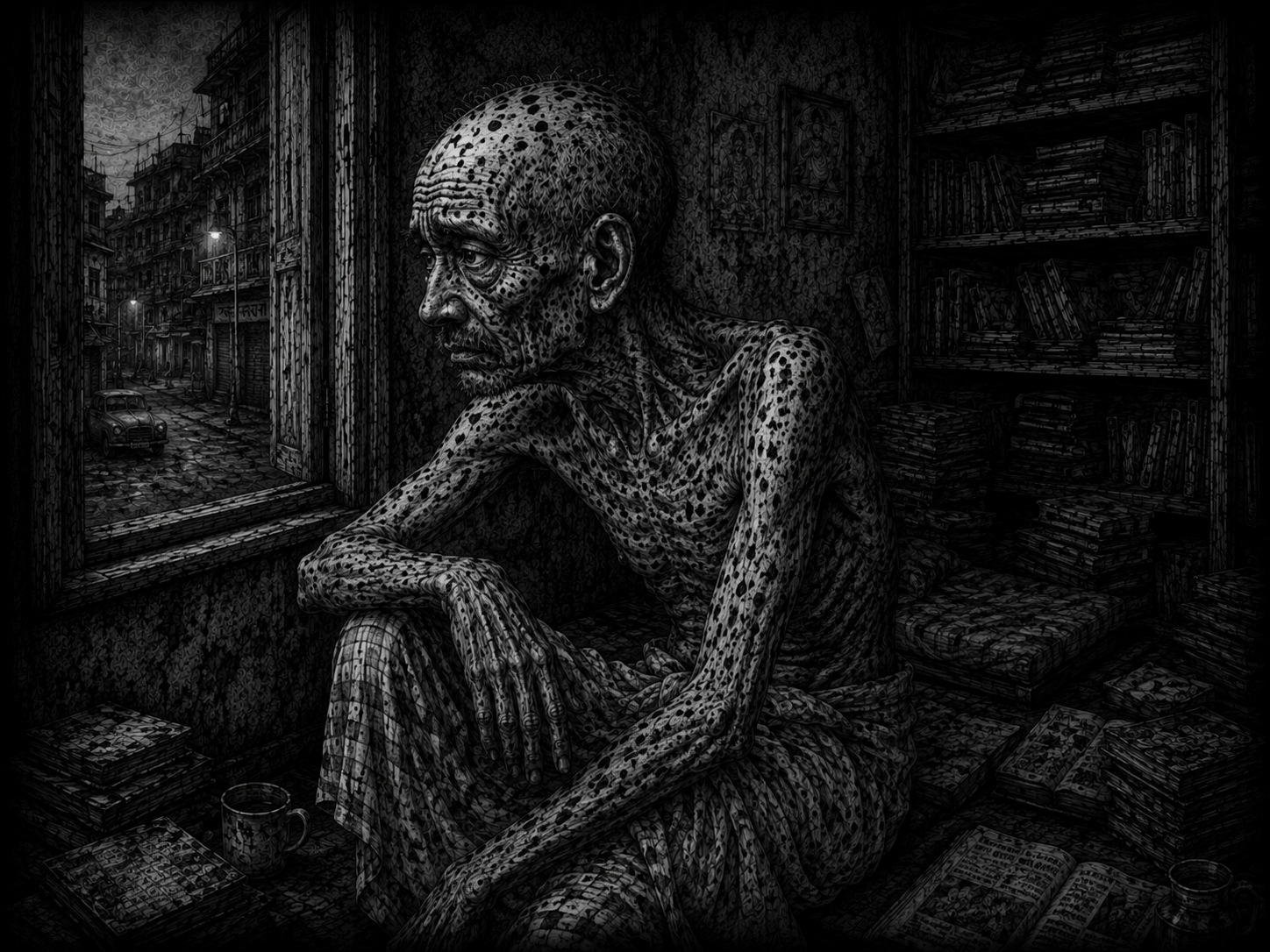
The laugh track comes out of the laptop like someone shaking a tin box full of old buttons, and I sit there in my Calcutta room, one knee folded under me, tea going cold, the ceiling fan making its heroic but frankly limited contribution to civilization, watching some man on screen trip over a sofa and become internationally hilarious.
The people inside the laptop laugh.
The people paid to laugh laugh.
The music tells me this is light.
I sit outside the whole arrangement like a damp parcel at Sealdah lost property, badly wrapped, faintly suspicious, and not expected to improve anyone’s day.
Once I understood comedy.
Not in the respectable way. Not as a theory. Not with some professor polishing his spectacles and explaining incongruity, superiority, relief, reversal, callback, and all the other laboratory labels with which clever people pin butterflies until even the butterfly says, “Dada, enough. Let me die in the garden.”
I understood comedy with the body.
Something happened on screen and some little goat inside the ribs kicked the bamboo fence. The lungs jumped. The mouth opened. The face became briefly idiotic. For three seconds the world, which normally sits on the neck like a sweating constable, stepped back and scratched itself.
That was laughter.
Now something else happens.
Not silence exactly. Silence would be simple. This is worse. Recognition without ignition. I can see the joke. I can see the little machinery. Here is the banana peel. Here is the pompous man deflated. Here is the lover caught lying. Here is the clerk humiliated. Here is the king discovered without clothes, dignity, or basic laundry management.
I see it.
I admire the carpentry sometimes.
But the laugh does not arrive.
The laugh, which once came like a local train without apology, now sends a polite notice: service discontinued due to emotional derailment. Passengers are requested to make their own arrangements.
So I sit through comedy like an unpaid exam invigilator in a school where all the students have already disappointed me. A film plays. People run in and out of rooms. Doors open at the wrong time. Someone hides behind a curtain. Someone pretends to be someone else. The background music jumps around like a well-fed puppy.
The director wants me lifted.
He has arranged the lamps, the timing, the edits, the cheerful confusion. He has built a world where nobody really starves, nobody really loses the roof over his head, nobody lies awake at four in the morning calculating whether his life has become a stale packet of muri inflated with failure and nitrogen.
Comedy requires trust.
That is the catch.
Not trust in God, nation, marriage, market, doctor, guru, party, policy, bank, app, or the latest smiling man on YouTube explaining how the economy is actually doing very well if you ignore the humans inside it. Comedy requires a tiny neurological trust that the world can bend without breaking.
A man slips on the floor and we laugh because we believe the bone will not come through the skin.
A husband is caught lying and we laugh because the marriage has not yet become a small border dispute with shared utensils.
A poor man pretends to be rich and we laugh because, in the world of the film, the electricity is still on, rice is still in the tin, and rent has not become a rabid dog scratching at the door.
But if your own life has become the thing comedy usually protects you from, comedy begins to look like a suspicious salesman.
It stands at the door with balloons.
You stand inside with a bucket.
The brain, naturally, has its own miserable plumbing. Laughter is not magic. People call things magic when they are too tired, too frightened, or too lazy to inspect the pipes. Surprise enters. Reward circuits stir. Social bonding opens one eye. Breath, face, throat, chest, and belly get involved like neighbors during a para quarrel. Dopamine says, “Something may be coming.” Endorphins soften the slap. The prefrontal cortex, that overeducated babu at the front desk, examines the contradiction and stamps it as amusing.
Then the body convulses politely.
Excellent system.
Evolution, that blind mechanic with grease on his elbow, probably kept laughter because it told the tribe, “Danger passed. Nobody dead. Continue chewing whatever unfortunate animal we caught.”
But depression is not sadness with a rainy window and a tasteful cigarette.
Depression is when the clerk in the reward office stops issuing coupons.
Comedy comes to the counter and presents a joke.
The clerk looks up and says, “Form incomplete.”
Next window.
Closed for lunch.
Come tomorrow.
Tomorrow is also closed.
This is anhedonia, a word that sounds like a minor Greek goddess appointed specifically to ruin birthdays. No pleasure. Or pleasure with the fuse removed. Food remains edible but not festive. Music remains patterned sound. Old songs arrive like relatives from a better decade and stand awkwardly by the door because you no longer have chairs for them. Desire becomes memory, nuisance, or low-battery fantasy. Comedy becomes an instruction manual for a machine you no longer own.
People say, “Watch something funny.”
As if the mind is a pressure cooker and comedy is the whistle.
As if one can pour in three YouTube clips, two old films, one British panel show, stir gently, and out comes cheer, steaming, salted, with coriander on top.
No, my friend.
When the mechanism is broken, a joke is only a skeleton with timing.
And yet the funny thing, because there is always a funny thing, even in the latrine of despair where the geckos judge your posture, is that my own life has become structurally comic.
Not joyful.
Not entertaining.
Comic in the cruel architectural sense. A mismatch between intention and result. A farce where every door opens onto another bill, every solemn declaration trips over a plastic bucket, and every little attempt at dignity comes out wearing underpants on its head.
A bright boy becomes a middle-aged clearance-sale item.
A man studies, works, crosses oceans, learns databases, hospitals, statistics, systems, the solemn machinery by which modern life pretends to understand itself, then returns to the great Indian circus where competence is often treated like a skin infection and honesty like a neurological defect.
And the final scene?
No violin.
No thunder.
No courtroom speech.
Just a man in a room on the edge of Calcutta deciding whether tea is worth the effort of boiling water.
This is comic.
Horribly comic.
A little hiccup of cosmic timing.
The tragedy is that the only audience seated close enough to see the sweat on the actor’s neck is me.
I am performer, spectator, sweeper, ticket seller, failed sponsor, and the fellow outside selling stale peanuts. The play begins every morning without my consent. Curtain rises. A man wakes up in a body that feels rented from a hostile landlord. Scene one: he remembers himself. Bad start. Scene two: he checks messages and finds either nothing or something worse than nothing. Scene three: stomach, bladder, unpaid thoughts, and the daily procession of small humiliations wearing bathroom slippers.
Somewhere offstage, society coughs and says, “Be positive.”
Society may kindly go polish its motivational slogans with phenyl.
Comedy movies now irritate me because they are too kind to consequence. Their chaos has choreography. My chaos has paperwork. In films, misunderstanding resolves. In life, misunderstanding grows legs. It becomes reputation, lost work, cousinly judgment, landlord tone, the small permanent stain on your name that nobody admits seeing but everyone politely steps around.
In comedy, the fool is forgiven because he is necessary.
In life, the fool is billed.
Henri Bergson said, more or less, that laughter comes when the mechanical is imposed upon the living. That is a very French way of saying people become funny when they behave like malfunctioning furniture. Sigmund Freud thought jokes released forbidden pressure from the basement of the mind. Both men had their points, though I suspect neither had to watch a buffering comedy film in a humid Calcutta room while his own life lay beside him like a dead fish wrapped in old newspaper.
The mechanical imposed upon the living?
That is my morning.
Wake. Dread. Pee. Check phone. Avoid. Regret. Tea. Delay. Think. Collapse. Repeat.
A loop so stupid it deserves a laugh track, except the laugh track has been repossessed.
The forbidden pressure?
Plenty. Rage, shame, envy, disgust, tenderness, fear, some ridiculous leftover hope, all packed into the chest like damp fireworks in a godown. But nothing explodes properly. It only smokes. A joke requires pressure to release upward. Mine leaks sideways.
This is why comedy can feel insulting when you are depressed. Not because comedy is bad. Comedy is one of the great human inventions, right up there with the umbrella, the pressure cooker, and the ability of Bengalis to discuss one blood test report for ninety-three minutes. But comedy assumes that the ground is still there under the joke.
Depression removes the ground.
Then someone says, “Lighten up.”
Lighten what?
This sack? This wet cement of memory? This kidney-shaped anxiety? This mental cupboard stuffed with undigested years?
I am not above comedy. I am beneath it, trapped under it, like a man under a collapsed pandal while the band keeps playing because the advance payment was non-refundable.
Sometimes I force myself. I select something beloved from the old days. A favorite actor. A famous scene. A film that once made me laugh so hard I nearly coughed out my spine. I sit ready to be rescued, which is already the mistake. Rescue is not comedy’s job.
Comedy is a matchstick.
It cannot relight a drowned city.
The scene begins.
Then comes the cruel part. Not laughter, but the memory of laughter. I remember the old me laughing. I see him faintly, that earlier fellow, lighter, thinner, not necessarily happy, but still chemically available to surprise. His nervous system had not yet become a locked government building with paan stains on the staircase. Failure had not audited him completely. Delight could still ambush him from behind a cupboard.
I watch him watching.
Then I watch myself watching him watching.
This is how the mind becomes a hall of mirrors in a cheap fairground. Every reflection is thinner, older, more badly lit, until the final man at the end is not even tragic. Just absurd. Hair gone. Teeth compromised. Pride in arrears. Sitting in a room and trying to remember why a fat man falling into a swimming pool was once enough to forgive existence for six and a half seconds.
Maybe that is the real obscenity.
Not that life is tragic.
That would at least have scale.
The obscenity is that life is often badly written comedy with no editor, too many minor characters, no pacing, poor lighting, and a protagonist who keeps missing his cue because he is in the bathroom negotiating with gas.
Outside, Calcutta continues. A vegetable seller shouts as if brinjal is a matter of national emergency. A bike squeezes through a lane built by people who evidently believed vehicles would remain goat-sized forever. Somewhere a political banner flaps with the confidence of wet underwear. The news talks of elections, markets, heat, apps, growth, outrage, rain warnings, and human beings reduced to statistics with shoes.
Inside, the rice cooker clicks off.
A small metallic sound.
Ridiculous.
Important.
And sometimes, just sometimes, some tiny damaged laugh escapes. Not during the movie. Never where requested. It comes when I catch myself giving a serious lecture to a cockroach about boundaries. Or when I spend twenty minutes looking for spectacles already sitting on my face like some low-budget Bengali King Lear of the bedsheet kingdom. Or when the fan makes a noise so tragic and loyal that it seems to be telling me, “I too had dreams once.”
That laugh is not light.
It is not uplifting.
It is more like a rat coughing behind the skirting board.
But it is mine.
Then the laptop screen goes dark and my face appears in it, ghostly, badly manufactured, not entirely recommended for public exhibition. For one second I look like the last remaining audience member at a matinee nobody advertised, still holding the ticket, still waiting for the funny part.
And somewhere inside the old Bengali machinery, a small sarcastic bubble rises, considers applause, and dies quietly.